How to buy e-money gift cards with crypto

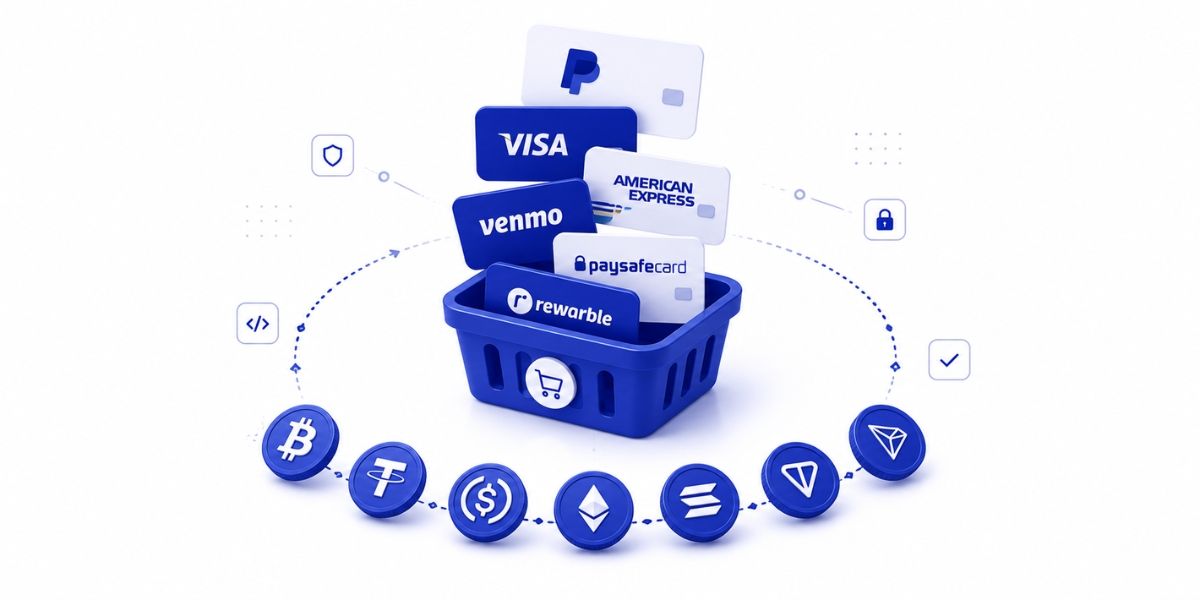
E-money gift cards are one of the most direct ways to turn crypto into spendable digital cash. Unlike store-specific gift cards, they load balance onto payment platforms like PayPal, Visa, American Express, Venmo, Paysafecard, and Rewarble that work across thousands of merchants, services, and online stores. If you hold Bitcoin, USDT, USDC, or any of 20+ supported coins, buying e-money gift cards with crypto on Cryptorefills takes under five minutes from wallet to delivery.
This guide covers the available e-money products, how purchase limits work, what to expect at redemption, and how to get through the process without common mistakes.
E-money gift cards available on Cryptorefills
The e-money category on Cryptorefills includes prepaid digital wallets and vouchers that can be redeemed for spendable balance. Products and their geographic scope vary; the table below reflects the current catalog.
Note on purchase limits for e-money products: Orders without a Cryptorefills account are capped at 200 EUR per card. With a Cryptorefills account the limit rises to 500 EUR per card. KYC-verified accounts can purchase up to 1,000 EUR per card and 5,000 EUR per day. E-money orders cannot exceed 1,000 EUR total per order. Cryptorefills recommends placing e-money orders separately from other gift card orders.
Supported cryptocurrencies for e-money purchases
Cryptorefills accepts a wide range of coins across multiple networks for e-money purchases. You do not need to hold a specific coin: any of the supported assets can be used at checkout.
Supported options include BTC on Lightning Network, ETH, USDC, USDT, PYUSD, DAI, EUROC, FDUSD, and LTC on networks including Ethereum mainnet, Polygon, Arbitrum, Avalanche, Base, Optimism, Binance Smart Chain, OKX, Solana, Tron, TON, Sui, Plasma, Sonic, and WorldChain. Exchange wallet payments via Binance Pay, Krak Pay, KuCoin Pay, and GatePay are also accepted.
How to buy e-Money gift cards with crypto
The steps are the same across all e-money products on Cryptorefills.
- Go to Cryptorefills and navigate to the Gift Cards section. Go to the "Emoney" category to see the full e-money catalog, or search for the specific product (e.g., Rewarble PayPal EUR).
- Select your product and denomination. Choose the currency and amount that matches your intended use. For PayPal products, select the currency that matches your PayPal account's region. For Paysafecard, select the denomination and region that is valid in your country.
- Add to cart and proceed to checkout. If you have a Cryptorefills account, log in before checkout to access higher purchase limits.
- Choose your payment coin and network. Select the cryptocurrency and blockchain network you want to pay with. The checkout page displays the exact amount due in your chosen coin, pulled from live pricing.
- Send the payment. Copy the payment address or scan the QR code. Send the exact amount shown to the provided address. Avoid rounding. Underpayments require a follow-up and delay delivery.
- Receive your code by email. Once the transaction confirms on-chain, your e-money gift card code is delivered to your email and displayed in your Cryptorefills account under "My Orders." Delivery is typically within minutes for fast-confirming networks.
Redeeming your e-money gift card
The redemption process depends on which product you purchased.
Rewarble products (PayPal, Visa, Super Gift Card): Visit rewarble.com/redeem and enter your 16-digit code. On Rewarble, choose your destination: for PayPal, enter your PayPal email address and the funds credit directly. For the Rewarble Visa USD, a virtual card (with card number, CVV, and expiration date) is generated for immediate use online. For the Rewarble Super Gift Card, you can split the balance across multiple products on the platform.
Rewarble balance does not expire once loaded into your Rewarble account. The initial gift card code is valid for 12 months from issuance, with an additional 12 months added when you redeem it into your Rewarble account.
For a full walkthrough of the Rewarble redemption flow, see the Rewarble gift card redemption guide.
Paysafecard: Once you have your 16-digit PIN, use it on any site that accepts Paysafecard at checkout. Select Paysafecard as the payment method, enter the PIN, and the balance is deducted from the card. Paysafecard is widely accepted across gaming, streaming, and online retail in its supported regions (~50 countries). The provider may request identity verification (KYC) above certain transaction thresholds.
Important: Avoid using a VPN when redeeming any e-money product. Mismatches between your account region and IP address are a common cause of activation failures.
Common mistakes to avoid
Paying the wrong amount is the most frequent issue. The checkout page quotes the exact amount in crypto due; the system does not auto-adjust for small differences. Send the amount shown, to the address shown, on the network you selected.
Choosing the wrong network is the second common issue. Sending USDT on Tron (TRC-20) to a USDT on Ethereum (ERC-20) address, for example, will result in a failed or lost payment. Confirm the network before sending.
For Rewarble products, the 16-digit code is one-use for loading into your Rewarble account. Once loaded, the balance is in your account and can be spent across products. Do not attempt to use the raw code as a payment method elsewhere.
If you plan to use a Rewarble Visa USD for merchant payments, check whether the merchant accepts virtual Visa cards with a third-party billing address. Not all merchants accept CVV-only virtual cards.
Frequently asked questions
- On Cryptorefills, you can buy several e-money gift cards with Bitcoin and other crypto, including Rewarble PayPal (in EUR, CAD, GBP, and AUD), Rewarble Visa USD, Rewarble Super Gift Card USD, and Paysafecard. The full list is visible under the Emoney category in the Gift Cards section. Product availability varies by region.
- Cryptorefills itself does not require KYC for purchases under 200 EUR per card without an account. With a Cryptorefills account, the limit rises to 500 EUR. KYC verification through Cryptorefills unlocks limits up to 1,000 EUR per card and 5,000 EUR per day. Separately, the redemption platform (such as Rewarble or Paysafecard) may request identity verification above certain thresholds on their end, regardless of what you verified with Cryptorefills.
- Cryptorefills accepts BTC on Lightning Network, ETH, USDT, USDC, PYUSD, DAI, EUROC, FDUSD, and LTC across networks including Ethereum, Polygon, Arbitrum, Base, Avalanche, Optimism, Binance Smart Chain, Solana, Tron, TON, Sui, and WorldChain. Exchange wallet payments via Binance Pay, Krak Pay, KuCoin Pay, and GatePay are also supported.
- Delivery happens automatically once the transaction is confirmed on-chain. For Lightning Network and faster-confirming blockchains, this is typically within one to two minutes. For Ethereum mainnet, expect two to five minutes depending on network congestion. The code is sent to the email address on your order and also stored in "My Orders" in your Cryptorefills account.
- Yes. You purchase a Rewarble PayPal gift card (available in EUR, CAD, GBP, and AUD) with crypto on Cryptorefills, then redeem the code at rewarble.com/redeem and enter your PayPal email address. Rewarble credits the amount directly to the specified PayPal account. The process does not require a bank account. Choose the currency that matches your PayPal account's region to avoid conversion fees.
- E-money orders on Cryptorefills cannot exceed 1,000 EUR total per order, regardless of account verification status. Per-card limits are 200 EUR without a Cryptorefills account, 500 EUR with an account, and 1,000 EUR with a KYC-verified account. Daily limits for KYC-verified accounts are 5,000 EUR. Cryptorefills recommends placing e-money orders separately from other gift card purchases.
- The most common causes are using a VPN during redemption (which causes a region mismatch), entering the code incorrectly, or attempting to use the raw gift card code directly as a payment method instead of loading it into your Rewarble account first. For Paysafecard, the PIN must be used on a merchant that supports Paysafecard in your region. If the code was entered correctly and the issue persists, contact the issuing platform's support (Rewarble or Paysafecard) with your order reference.
- The Rewarble Visa USD is a virtual card. After redeeming your Rewarble code at rewarble.com/redeem, a virtual card is created in your Rewarble account with a card number, CVV, and expiration date. You use these details to pay online at any merchant that accepts Visa. It is not a physical card and cannot be used at point-of-sale terminals. Note that some merchants do not accept virtual Visa cards from third-party issuers, particularly for subscription billing.
- The Rewarble Visa USD is a virtual card. After redeeming your Rewarble code at rewarble.com/redeem, a virtual card is created in your Rewarble account with a card number, CVV, and expiration date. You use these details to pay online at any merchant that accepts Visa. It is not a physical card and cannot be used at point-of-sale terminals. Note that some merchants do not accept virtual Visa cards from third-party issuers, particularly for subscription billing.