Buy gift cards in bulk with USDC

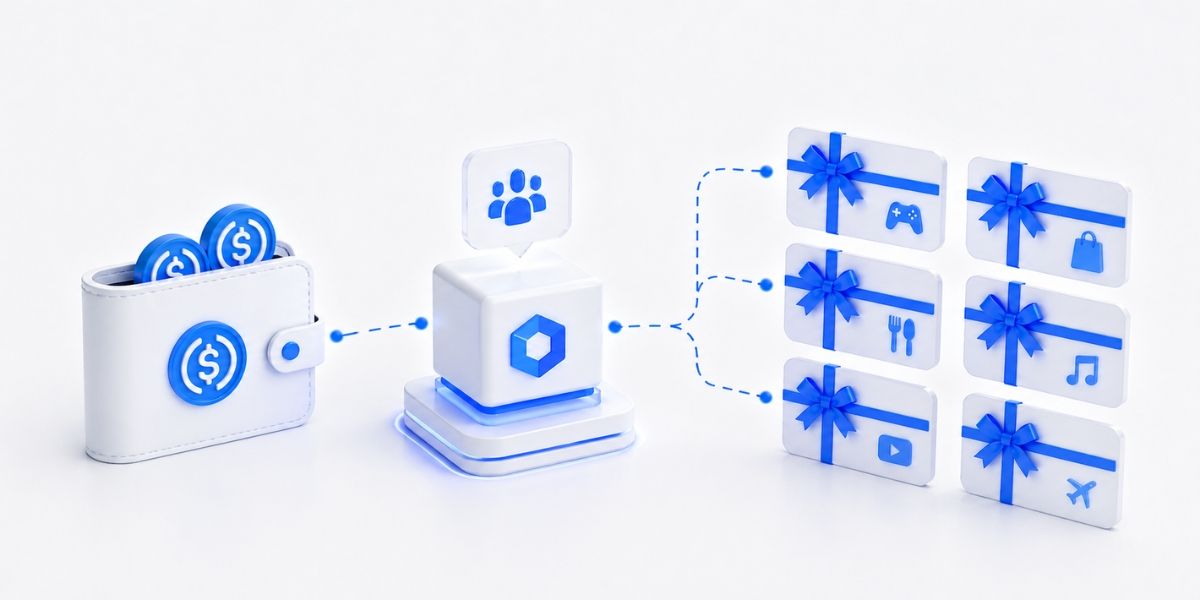
Most bulk gift card infrastructure was built for HR teams with a corporate credit card and a US bank account. If your treasury is in USDC, that's the wrong starting point. This article is for operators who need to distribute gift cards at scale from a stablecoin treasury, without converting to fiat first and without putting end users through an identity check.
Who this is for
DAOs distributing contributor rewards. Governance participants, bounty completions, and grant recipients are a natural fit for gift card payouts. A $25 Amazon or $50 Airbnb voucher lands in someone's inbox and is spendable that day. A token transfer still needs to be sold before it's useful to most people.
DeFi protocols running incentive programs. Liquidity mining rewards, testnet participation incentives and community campaigns work better when the reward is something people can spend the same day. Paying in stablecoins from your treasury and issuing a digital voucher on the other end removes the off-ramp problem.
Crypto gaming platforms and prize pools. Tournament prizes, in-game achievement rewards and season-end payouts distributed at scale to players across dozens of countries. One API call per order, regardless of where the recipient is.
Remote crypto-native teams. Corporate gifting, holiday bonuses, and team rewards for globally distributed teams who don't share a banking system. A gift card in the recipient's local market, settled from a shared USDC wallet, is the path of least friction.
How the bulk order flow works
The Cryptorefills B2B gift card API is a REST API covering the full order lifecycle. For bulk distribution, the flow is the same per order whether you're issuing one card or a thousand: get a live price, validate the order, create it, track delivery. Each step is a separate endpoint call, which means your backend can run validation before committing payment, and handle individual order failures without stopping the whole batch.
Settlement is in USDC or USDT on your preferred network. Solana and Base are the fastest options for high-volume runs, with transaction finality in seconds. Compare that to the one-to-several business days it takes to fund a fiat account via ACH. There's no prefunded balance to top up. Each order draws from your treasury wallet at the moment of creation, so your working capital stays available until the moment you actually need it.
For teams running larger volume programs, the partnerships team can discuss custom catalog access, dedicated support, and volume terms.
Brands, denominations and countries
The catalog covers 6,600+ brands across 180+ countries. That includes major global brands (Amazon, Google Play, Apple, Netflix, Spotify, Airbnb), regional retail and food delivery, gaming credits, mobile top up and more. Denominations vary by brand and country.
The 180+ country coverage matters most for globally distributed teams and DAO communities. You're not managing multiple regional providers or handling currency conversion yourself. The catalog returns locally relevant products for each recipient's country through the same endpoint.
Settlement speed and working capital advantage
Every fiat-based bulk rewards platform requires you to prefund an account before you can issue a single card. Capital leaves your treasury before you've distributed anything, and if redemption volume is uneven, that balance sits idle.
With USDC on Solana or Base, payment happens at the point of order creation and settles in seconds. Your treasury retains the funds until an order is triggered, and the per-order cost is the face value of the card plus network fees that are negligible at these transaction sizes, without idle capital or reconciliation lag.
This is important for protocols managing treasury spend across multiple programs at once. It allows you to draw from a single wallet in real time without dividing a prefunded balance across campaigns.
Tax and compliance note
Gift card distribution from a DAO or protocol treasury may carry tax reporting obligations depending on your jurisdiction and the nature of the distribution (contributor compensation, prizes, community rewards, etc.). Cryptorefills processes orders and delivers vouchers. It does not act as a tax agent, withholding agent or compliance intermediary on your behalf. Operators are responsible for their own obligations under applicable law.
Cryptorefills operates under its own trust and safety standards. See the trust and safety page for detail on how orders are processed and what restrictions apply by jurisdiction. Terms and conditions apply.
Scenario: how a 1,000-person DAO distributed $25,000 in Amazon gift cards from treasury USDC
The following is an illustrative example.
A DAO running a six-week contributor sprint wanted to reward 1,000 participants with a $25 Amazon gift card at the end of the program. Total value is $25,000 and the treasury held USDC on Solana.
The options considered were a fiat rewards platform (which would require $25,000 prefunded in USD before distribution, plus ACH lag) and a manual crypto payout to each wallet (which would require recipients to sell tokens themselves before spending).
Using the Cryptorefills B2B gift card API, the core team made sequential order calls against the API for each contributor address mapped to a delivery email. Each order settled in USDC at the live rate, with delivery to the recipient's inbox on confirmation. The full $25,000 in bulk gift cards was distributed over a single session without converting treasury funds to fiat at any point. Recipients in 34 countries received an Amazon denomination localized to their market.
The treasury held the full $25,000 until distribution began without idle balance and no ACH wait.
Get started with bulk gift card distribution
For high-volume programs, integrations and enterprise terms: Talk to the partnerships team to discuss your use case, volume and catalog needs.
For direct API integration: Open developer docs for endpoint reference, supported coins and the full order lifecycle.