How to spend USD1 on gift cards and travel in 2026
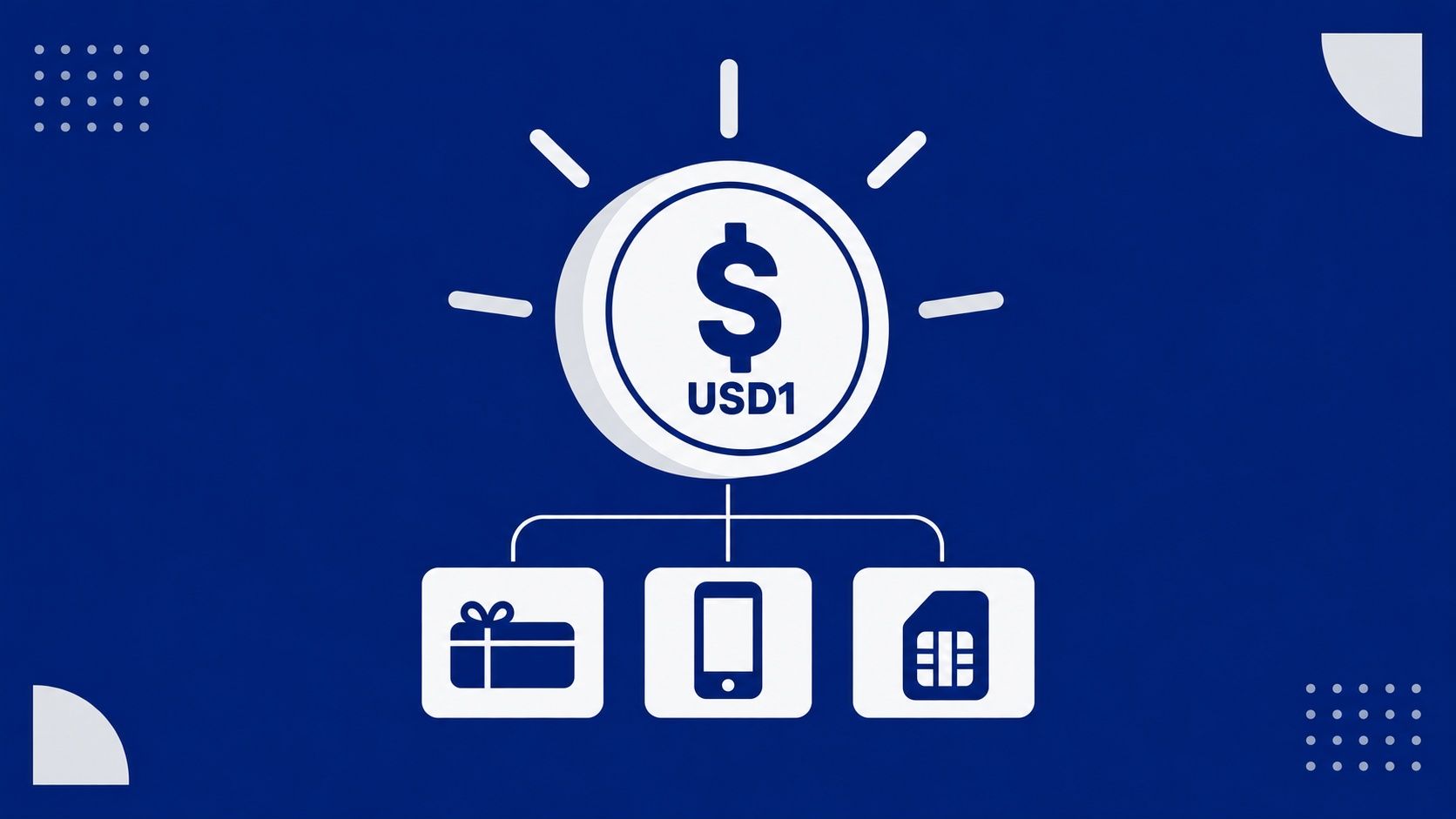
USD1 is accepted at Cryptorefills. You can pay with it directly at checkout across the full catalog: gift cards for 6,600+ brands, eSIMs for 200+ countries, mobile top-ups, and Cryptorefills Flights covering 300+ airlines. USD1 also settles Binance Pay transactions at Cryptorefills, so holders paying via Binance Pay are spending USD1 whether they selected it directly or not.
USD1 is a dollar-pegged stablecoin issued by World Liberty Financial and custodied by BitGo Trust, backed by cash deposits and short-term US Treasury securities. It launched on Ethereum and BNB Chain in March 2025 and had grown to approximately $4 billion in circulating supply by mid-2026. As of September 2026 it is deployed across ten blockchain networks. The spend path at Cryptorefills is the same as any other supported stablecoin: select your product, choose USD1 at checkout, send the exact amount to the generated address, receive the product by email.
How to pay with USD1 at Cryptorefills
Step 1. Go to Cryptorefills, select a product and denomination.
Step 2. At the payment screen, select USD1 as the coin.
Step 3. Send the exact amount shown to the generated payment address. USD1 is pegged to $1, so the amount displayed is the USD price with no conversion calculation needed.
Step 4. The product is delivered to your email address within two to five minutes of on-chain confirmation.
USD1 via Binance Pay
If you hold USD1 in your Binance spot wallet, you can spend it at Cryptorefills through Binance Pay without sending it on-chain. Select Binance Pay at the payment screen, approve the transaction in the Binance app, and the order processes immediately. USD1 is the settlement currency Binance uses for Cryptorefills Binance Pay transactions, which means this path is available to any Binance user holding USD1, USDT, XRP, or other supported Binance spot assets , Binance converts internally to USD1 to settle the merchant side.
What USD1 is and why it is on Cryptorefills
USD1 is issued by World Liberty Financial and custodied by BitGo Trust Company. Each token is backed by US dollars and short-term US Treasury securities held through government money market funds. The reserve structure is similar to USDC and USDT in that it is fiat-collateralized and regularly attested. As of August 2026, reported reserves stood at approximately $4.013 billion against $4.012 billion in circulating supply.
The key difference from USDC and USDT is the issuer. USD1 is affiliated with World Liberty Financial, which is backed by the Trump family. Whether that matters for spending purposes depends on the user. From a payments standpoint, USD1 behaves identically to any other dollar-pegged stablecoin at Cryptorefills checkout: you send an amount, the order processes on confirmation, and the product is delivered. The political affiliation of the issuer does not affect the peg mechanics or the checkout flow.
The stablecoin launched in March 2025 and reached a circulating supply near $4.5 billion by Q1 2026, making it one of the fastest-growing fiat-backed stablecoins of the period. Binance Pay's adoption of USD1 as a settlement currency accelerated its practical reach considerably, since Binance Pay is accepted by a significant number of crypto-friendly merchants including Cryptorefills.
USD1 compared to USDC and USDT for spending
For the purpose of buying a gift card or booking a flight on Cryptorefills, the practical differences between USD1, USDC, and USDT come down to which network you are using and where you hold the balance. All three settle at $1. All three deliver the same products from the same catalog. The network fee and confirmation time depend on the chain, not the stablecoin name.
If you already hold USD1 on a supported network, there is no reason to convert it to USDC or USDT before spending. The checkout accepts USD1 directly. If you are deciding which stablecoin to acquire specifically for spending at Cryptorefills, USDT on Tron remains the lowest-fee option for amounts under $50, and USDC on Solana remains the fastest for general use. USD1 is the practical choice when you already hold it or when you are paying via Binance Pay.
Frequently asked questions
- Yes. USD1 appears as a selectable payment coin at the Cryptorefills checkout. Select it as the payment method, send the exact amount shown to the generated address, and the product is delivered by email after on-chain confirmation. USD1 is also the settlement currency Binance uses when you pay via Binance Pay at Cryptorefills, so Binance Pay users are already spending USD1 on the merchant side regardless of which coin they selected on the Binance side.
- The full catalog is available: gift cards for 6,600+ brands across 180+ countries, eSIM data plans for 200+ countries, mobile top-ups for 600+ operators globally, Rewarble Visa USD prepaid cards ($20–$500, global), Amex Gift Cards ($5–$2,000, US catalog), and Cryptorefills Flights covering 300+ airlines. The catalog is the same as for any other supported coin.
- USD1 is a US-dollar stablecoin issued by World Liberty Financial, a company affiliated with the Trump family, and custodied by BitGo Trust Company. Each token is backed 1:1 by cash deposits and short-term US Treasury securities. It launched on Ethereum and BNB Chain in March 2025 and had approximately $4 billion in circulating supply by mid-2026, distributed across ten blockchain networks.
- For gift card purchases on Cryptorefills, USD1 behaves identically to USDC and USDT at the checkout level. All three are dollar-pegged stablecoins accepted directly. The practical difference is where you hold the balance and which network you send from. If you already hold USD1, use it directly. If you are buying stablecoins specifically to spend on Cryptorefills, USDT on Tron carries the lowest fees for amounts under $50 and USDC on Solana offers the fastest confirmation for general use.
- In most jurisdictions, spending any cryptocurrency , including stablecoins , on goods or services triggers a capital gains calculation based on the difference between acquisition cost and value at the time of spending. For a stablecoin pegged to $1, the gain or loss is typically minimal (the peg fluctuates by fractions of a cent), but the taxable event still occurs in jurisdictions that treat crypto as property. Tax rules vary by country. Confirming the specifics with a tax professional familiar with crypto in your jurisdiction is advisable for significant purchases.
- Binance Pay uses USD1 as its merchant settlement currency for Cryptorefills transactions, as shown in the order detail screen. When a user pays via Binance Pay , regardless of which coin they hold in their Binance spot wallet , Binance converts internally and delivers USD1 to the Cryptorefills order. This is a Binance Pay configuration choice, not a Cryptorefills-specific decision, and it reflects USD1's growing role as a settlement currency within the Binance ecosystem following Binance's integration with World Liberty Financial's stablecoin infrastructure.
- Binance Pay uses USD1 as its merchant settlement currency for Cryptorefills transactions, as shown in the order detail screen. When a user pays via Binance Pay , regardless of which coin they hold in their Binance spot wallet , Binance converts internally and delivers USD1 to the Cryptorefills order. This is a Binance Pay configuration choice, not a Cryptorefills-specific decision, and it reflects USD1's growing role as a settlement currency within the Binance ecosystem following Binance's integration with World Liberty Financial's stablecoin infrastructure.