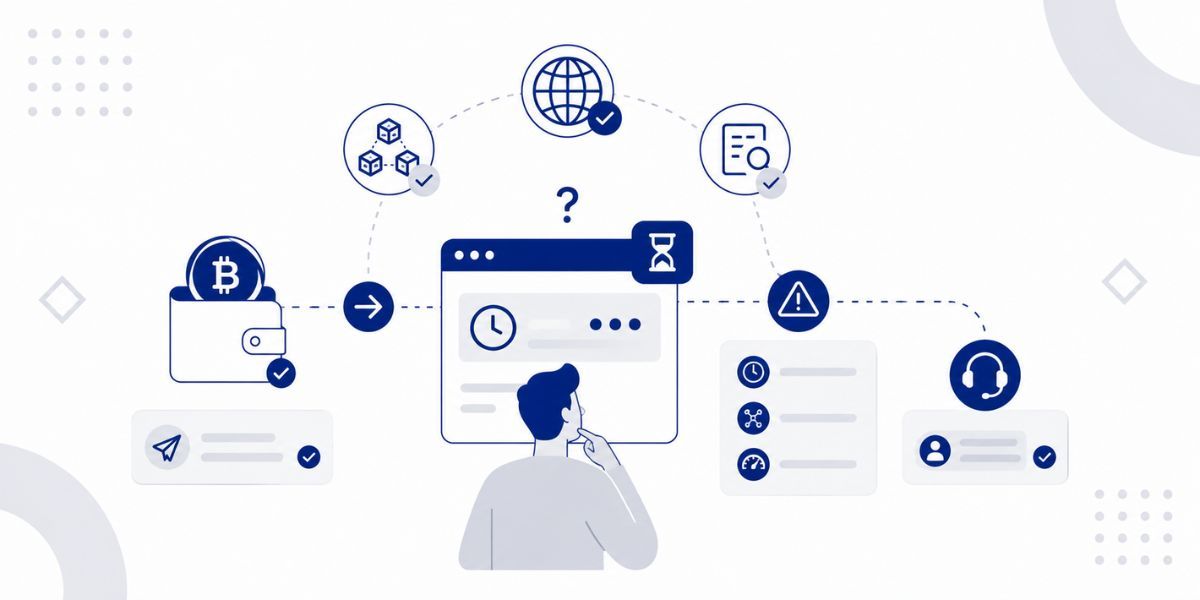
When a payment is sent from a wallet to the Cryptorefills payment address, the transaction passes through the blockchain network before it reaches the point of being readable by the order system. On faster networks such as Solana and Base, this process typically completes within seconds. On Bitcoin and Ethereum mainnet, the process can take considerably longer depending on network congestion and the transaction fee applied at the time of sending. During this interval the order shows as pending, which is the correct state for a payment that has been sent but not yet confirmed on-chain.
The most useful first step when a payment appears delayed is to locate the transaction on a block explorer, which is a publicly accessible tool that displays the real-time status of any transaction on a given blockchain. This step determines whether the transaction has been broadcast to the network at all, whether it is waiting in the mempool due to a low fee, or whether it has been confirmed and the issue lies elsewhere.
Every wallet application records the transaction hash for each outgoing payment. On most wallets, this is accessible by tapping or clicking the transaction in the history and locating a field labelled "transaction hash," "transaction ID," or "TXID." The hash is a long alphanumeric string that uniquely identifies the transaction on the network.
To check the status, navigate to the block explorer for the network used (listed in the table above), paste the transaction hash into the search field, and submit. The result page will show one of three states: the transaction has been confirmed (indicated by a confirmation count above zero or a "Success" status), it is pending in the mempool (shown as "Pending" with zero confirmations), or it does not appear at all (which indicates the transaction was not broadcast to the network by the wallet). Each state has a different appropriate response.
If the block explorer shows the transaction as confirmed and the correct amount was sent to the correct address on the correct network, the order should update automatically within a few minutes. If the order has not updated after ten minutes of the on-chain confirmation, contact Cryptorefills support with the transaction hash and order number. Do not send a second payment.
A transaction sitting in the mempool has been broadcast to the network but has not yet been included in a block, typically because the fee attached was lower than what miners or validators are currently accepting. On Bitcoin and Ethereum, the mempool.space and etherscan.io explorers show the current minimum fee required for inclusion, which can be compared against what was sent. Some wallets support a replace-by-fee (RBF) function on Bitcoin, which allows a new transaction with a higher fee to replace the pending one. On Ethereum, some wallets allow the gas price on a pending transaction to be increased (known as "speeding up" a transaction). The specific steps depend on the wallet application in use.
If the transaction hash is not found on the block explorer, the transaction was either not broadcast to the network or was broadcast and immediately rejected. In this case, the funds have not left the wallet. Check the wallet balance to confirm the funds are still present, and attempt to send the transaction again. If the wallet continues to show the transaction as sent but it does not appear on the explorer, the wallet application may have a connectivity issue and restarting it or switching to a different network connection may resolve the problem.
Support should be contacted when the transaction has been confirmed on the block explorer but the order has not updated after ten minutes, or when the order has expired and a payment is visible on-chain. The information required for support to investigate the order efficiently includes the Cryptorefills order number, the transaction hash from the block explorer, the network on which the payment was sent, and the token used. Providing this information at the outset significantly reduces the time required to resolve the case. The guide on exact payment amounts covers the scenario where the confirmed amount differs from what was required.
For fast networks such as Solana and Base, if the transaction is confirmed on the block explorer and the order has not updated within five to ten minutes, contacting support is appropriate. For Bitcoin and Ethereum mainnet, where confirmation times can be longer depending on network conditions, checking the block explorer first to confirm the transaction status is the most useful step before reaching out. A transaction still pending in the mempool is not a case for support; it requires waiting for network inclusion or using the wallet's fee-acceleration feature if available.
Sending a second payment before the first has been resolved creates a situation where two payments are associated with a single order, which complicates the resolution process considerably. The correct approach is to check the block explorer first, then contact support with the transaction hash before taking any further action. If the first payment was not broadcast to the network at all, a new order can be created; support can advise on this based on the specific situation.
The transaction hash is recorded by the wallet application when the payment is sent. In most wallets it is accessible by opening the transaction in the transaction history and locating the field labelled "transaction hash," "transaction ID," or "TXID." It is a long alphanumeric string. If the wallet does not display a transaction hash, the transaction may not have been successfully broadcast, which can be verified by checking whether any transaction is visible on the block explorer when searching by the sending wallet address.
A failed Solana transaction means the transaction was submitted to the network but was rejected during execution. This is different from a pending or unconfirmed state: a failed transaction is final and the funds were not moved. The wallet balance should reflect that the funds are still present. A new order should be created on Cryptorefills and a new payment sent. The Solana payment guide covers common reasons for failed transactions on that network.
If a payment was sent before the order expired but the on-chain confirmation arrived after the expiry time, the payment is still visible on the blockchain and the funds were moved from the wallet. This is distinct from an order that expired with no payment sent. Contact Cryptorefills support with the transaction hash and order number; support can match the confirmed payment to the expired order in these circumstances.