How to Pay With USDT and USDC on X Layer

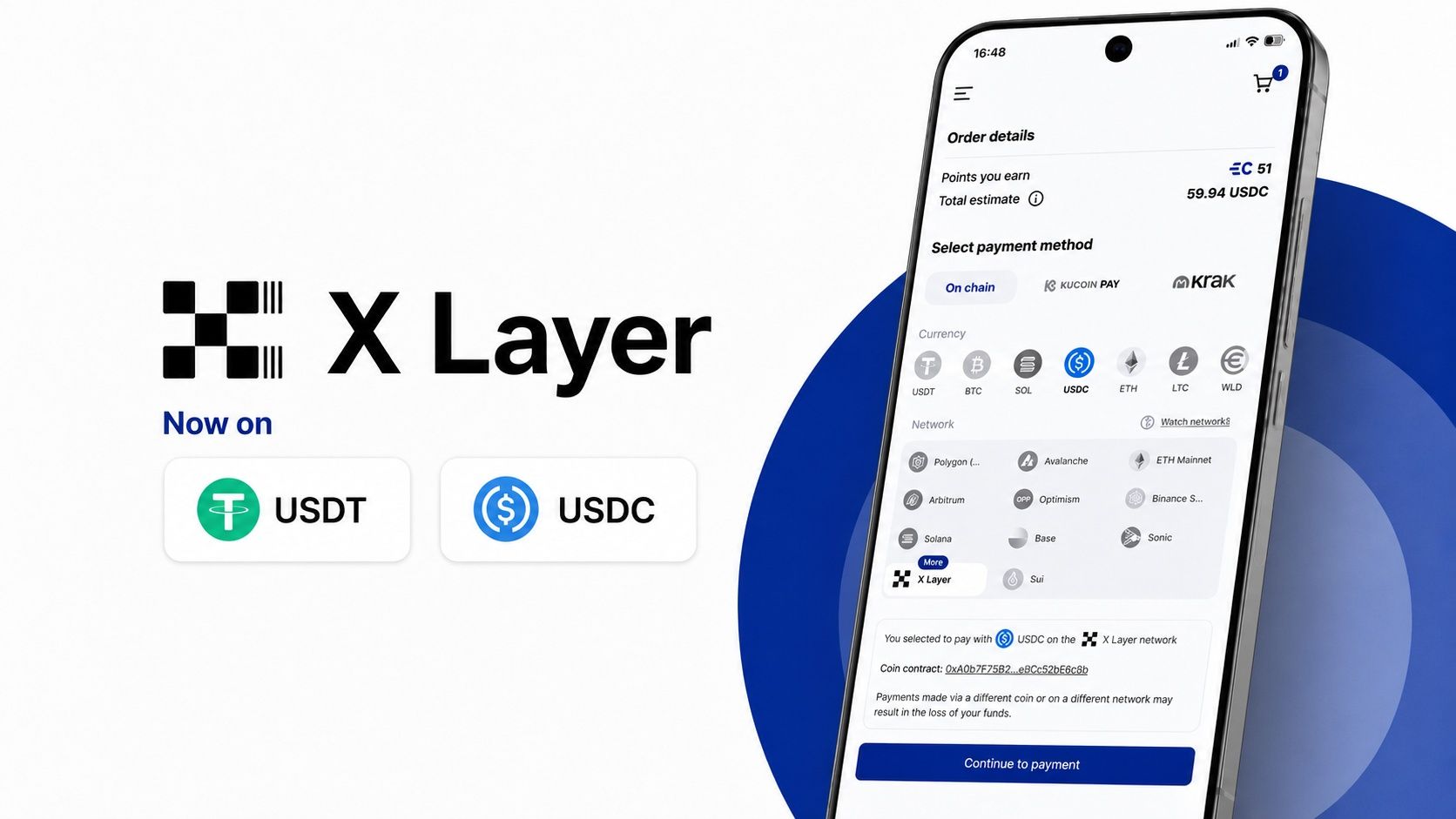
USDT and USDC on X Layer are both accepted across the full Cryptorefills catalog. X Layer is OKX's Ethereum Layer 2, and it's a straightforward network to pay from once you know that gas is charged in OKB. A wallet carrying only stablecoins will stall at the point of signing.
The other thing to check is what you've read about the network elsewhere, since X Layer changed architecture during 2025 and most published guides still describe the old design.
What X Layer is now
X Layer launched in April 2024 as a zkEVM validium built on Polygon CDK. That was true until 2025, when an upgrade raised throughput substantially and OKX migrated the network to an enhanced OP Stack, the same framework behind Base and Optimism. Cross-chain settlement still runs through Polygon's AggLayer.
X Layer now behaves as an optimistic rollup with full EVM equivalence, so any wallet that works with Ethereum works here without a plugin.
Most third-party coverage continues to describe X Layer as a zkEVM chain on Polygon CDK. If you're following an older guide to add the network manually or bridge into it, that's the gap to watch for.
When X Layer is the right network to pay from
Fees run around $0.0005 per transaction with one-second blocks, which makes the network cost of a gift card purchase a rounding error. Solana and Base sit at similar levels, so the fee alone won't decide anything for you.
X Layer is tightly integrated with the OKX exchange, and withdrawing USDT or USDC from an OKX account straight onto X Layer is faster and cheaper than routing the same funds through Ethereum mainnet or a third-party bridge. If you hold stablecoins on OKX, this is the shortest path from an exchange balance to a spendable product.
If your stablecoins are somewhere else entirely, bridging them to X Layer for a single purchase costs you more than it saves. Paying from wherever they already sit is the better call, and the guide to paying with SOL covers that route.
Something we noticed from the checkout side: X Layer payments began arriving before we announced support for the network. Users were selecting it and paying from it while it sat unlisted, which is usually a sign that a network has real holders behind it.
OKB is the gas token, and it catches people out
X Layer charges gas in OKB. A wallet holding USDT on X Layer and nothing else will refuse to build the transaction, because there's no OKB in it to pay the fee.
Sourcing OKB has changed too. Supply is now fixed at 21 million following a large burn, and OKB on Ethereum mainnet has been phased out, so bridging it in from Ethereum is no longer the route it once was. A small withdrawal of OKB from an OKX account directly to X Layer is the cleanest way to top up.
You need very little of it. A dollar's worth covers a very large number of transactions at current fee levels, which is why arriving with an empty gas balance is the only version of this problem worth planning around.
How to pay with USDT or USDC on X Layer
Step 1. Check that you hold a small amount of OKB on X Layer for gas. If you hold none, withdraw a dollar or two of OKB from OKX to X Layer before going any further.
Step 2. At Cryptorefills checkout, select USDT or USDC as your payment token.
Step 3. Choose X Layer from the network list. Picking the wrong network is the most common cause of failed crypto payments, so this is the step to slow down on. The guide to selecting the correct currency and network covers what happens when it goes wrong.
Step 4. Send the exact quoted amount from any X Layer wallet, including directly from an OKX account. Scanning the payment QR removes the most common source of error, which is a hand-copied address.
What USDT0 means for your balance
USDT on X Layer is issued as USDT0, the omnichain deployment of Tether's USDT built on LayerZero's Omnichain Fungible Token standard and backed 1:1 by USDT locked on Ethereum.
At checkout it behaves exactly as USDT. Select the token, select the network, send the amount.
The distinction starts to matter if you're moving balances between chains yourself, because USDT0 arrives as a native asset on the destination chain and liquidity bridges handle it differently from canonical USDT.
If the payment does not arrive
X Layer blocks confirm in about a second, so a payment that hasn't registered within a minute has usually failed to broadcast at all. Check the transaction on the explorer OKX lists in its current documentation. Older guides point to OKLink, which changed after the migration.
Our article on what to do when a crypto payment is not confirmed covers the three states a transaction can be in on an explorer and what each one means.
One thing to factor in before you move funds off X Layer instead of spending them. Because the network runs as an optimistic rollup, withdrawals to Ethereum through the official bridge carry a challenge window of around seven days. Liquidity bridges move faster under different trust assumptions. The window applies to bridge withdrawals only, so checkout payments are unaffected by it.
Frequently asked questions
- X Layer is OKX's Ethereum Layer 2 network. It runs on an enhanced OP Stack with one-second blocks and average fees around $0.0005 per transaction, settling cross-chain through Polygon's AggLayer. OKB is its gas token.
- X Layer launched as a zkEVM validium on Polygon CDK in April 2024, and OKX migrated it to an enhanced OP Stack during 2025. It now operates as an optimistic rollup with full EVM equivalence. Coverage describing it as a zkEVM chain predates that migration.
- Yes. OKB is the gas token on X Layer, so a wallet holding only stablecoins will refuse to build a transaction. A withdrawal of one or two dollars of OKB from an OKX account covers a very large number of transactions at current fee levels.
- Any X Layer-compatible wallet works at Cryptorefills checkout, including MetaMask with the network added manually. An OKX account is convenient for two reasons: you can pay directly from it if your balance sits there, and it's the simplest source of OKB for gas.
- The full Cryptorefills catalog: gift cards, mobile top-ups, eSIMs, flights, and hotel bookings. Every product available at checkout accepts this network.
- USDT0 is the omnichain deployment of Tether's USDT on X Layer, built on LayerZero's Omnichain Fungible Token standard and backed 1:1 by USDT locked on Ethereum. At checkout it behaves as USDT.
- All three sit in the same fee bracket, low enough that network cost is negligible on a normal purchase. Where your balance already is decides it. X Layer is the shortest route from an OKX account to a purchase, and Solana or Base will cost you less overall if your stablecoins are already sitting there, because you skip bridging entirely.
- USDT on X Layer went live on 21 July 2026 and USDC on 8 August 2026, making X Layer the 20th network available at Cryptorefills checkout.
- USDT on X Layer went live on 21 July 2026 and USDC on 8 August 2026, making X Layer the 20th network available at Cryptorefills checkout.